


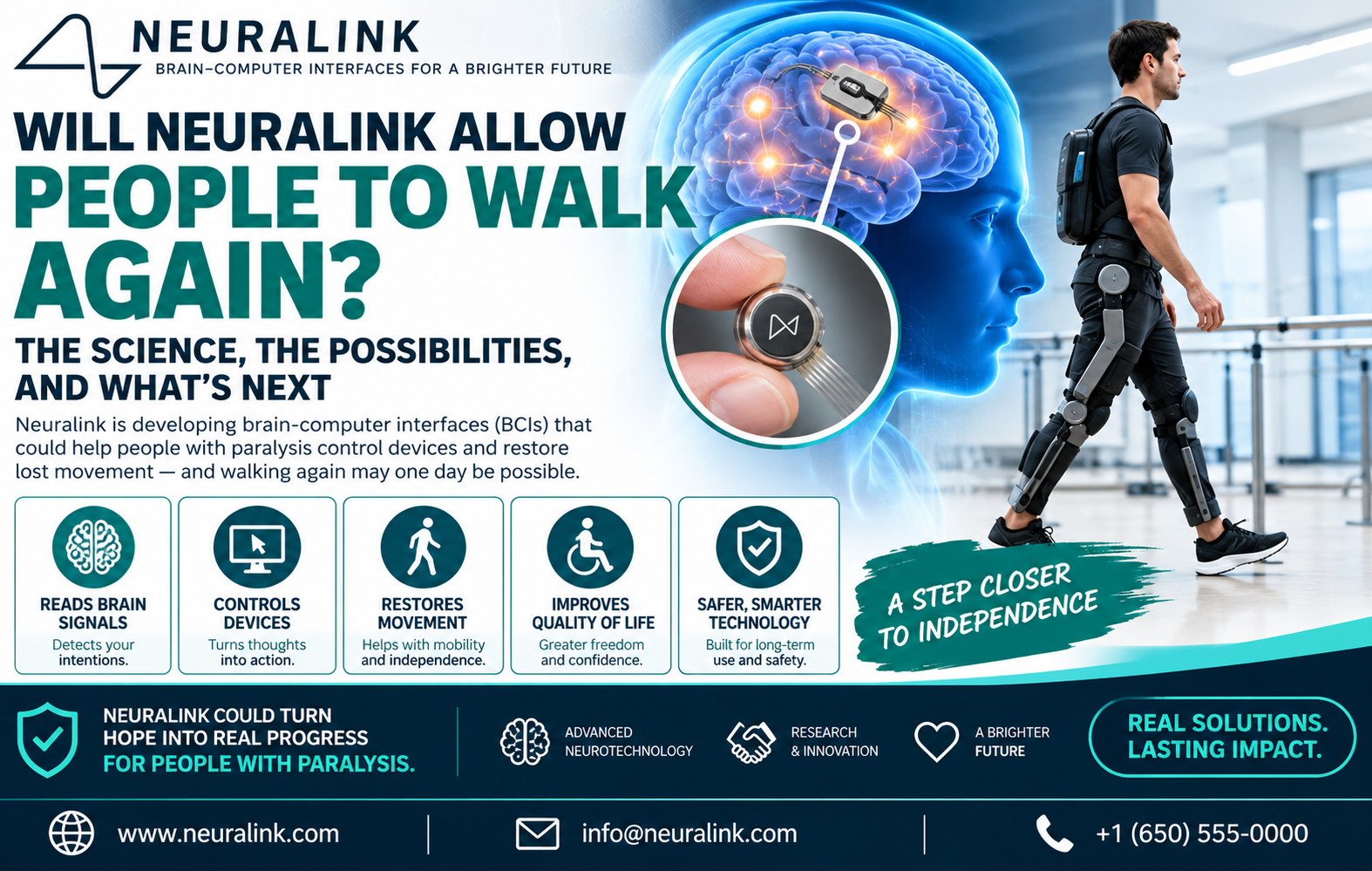
The possibility of helping paralyzed people walk again is one of the most ambitious goals in brain-computer interface research. Neuralink, the brain-computer technology company founded by Elon Musk, is developing implantable devices designed to record signals from the brain and translate them into commands for computers and other technologies.
A major question is whether this technology could eventually help people who have lost the ability to walk regain control of their legs. The answer is potentially, but it is not yet a proven treatment for restoring natural walking.
How Could Neuralink Help Someone Walk Again?
Walking involves communication between the brain, spinal cord, and muscles. When the spinal cord or parts of the nervous system are seriously damaged, signals from the brain may no longer reach the muscles correctly.
A brain-computer interface could potentially create a new communication pathway.
Instead of relying entirely on damaged neural pathways, an implanted device could detect movement intentions from the brain. These signals could then be processed by a computer and converted into commands for an external device, spinal stimulation system, or other technology.
In a future system, a person might think about moving their legs, and the technology could translate that intention into signals that help activate the muscles or stimulate the spinal cord.
What Has Neuralink Demonstrated So Far?
Neuralink’s early human trials have primarily focused on allowing people with severe disabilities to control digital devices using brain signals.
The company’s PRIME study is designed to investigate whether its implant and surgical robot can safely enable people with paralysis to control external devices using neural activity.
Early demonstrations have shown brain-computer interfaces being used for tasks such as controlling a computer cursor. These developments are important because they demonstrate that brain signals associated with intended movements can be detected and translated into useful commands.
However, controlling a computer is very different from restoring the complex biological process of walking.
Could a Brain Implant Bypass a Spinal Cord Injury?
One of the most interesting possibilities is creating an artificial communication bridge around damaged parts of the nervous system.
Researchers have been investigating combinations of brain implants and spinal stimulation for this purpose. In such an approach, brain activity could indicate that a person wants to stand or walk. A computer system could interpret those signals and send appropriate stimulation to the spinal cord or muscles.
This could potentially help restore movement even when normal communication between the brain and lower body has been disrupted.
Importantly, this concept is not exclusive to Neuralink. Universities and medical research groups around the world are also studying brain-computer interfaces, spinal stimulation, neuroprosthetics, and related technologies.
Would Neuralink Restore Natural Walking?
This is where expectations need to remain realistic.
Walking is an extremely complicated process. The nervous system has to coordinate balance, muscle activation, sensory feedback, posture, and timing. A system capable of moving a cursor is much simpler than one capable of reproducing these functions.
A future brain-computer system might assist movement without completely restoring normal neurological function. For example, it could potentially work with robotic devices, electrical stimulation, or rehabilitation equipment.
Researchers would also need to determine how reliably the system works, how long the implant remains functional, and whether users can safely operate it over many years.
What About People With Different Types of Paralysis?
The potential benefits could vary considerably depending on the cause and severity of paralysis.
Someone with a spinal cord injury may have very different remaining neural pathways compared with someone who has suffered a neurological disease or another type of nervous-system damage.
The location of the injury is also important. If certain nerves, muscles, or spinal pathways remain functional, technology may be able to work with those existing systems.
Therefore, it would be inaccurate to assume that one Neuralink system could allow every person with paralysis to walk again.
Neuralink and the Future of Neurotechnology
Neuralink is part of a broader movement toward advanced brain-computer interfaces. The long-term objective of this field is to create reliable communication between the nervous system and electronic devices.
Potential applications include controlling computers, robotic limbs, communication systems, and assistive technologies.
For people with severe paralysis, even partial restoration of movement or greater independence could have significant practical value.
However, these technologies are still developing. Human trials must establish safety, reliability, effectiveness, and long-term performance before such systems can become widely available medical treatments.
What Challenges Still Need to Be Solved?
Several major challenges remain.
Safety: Implanting electrodes into the brain requires surgery and carries medical risks.
Signal stability: Brain signals can change over time, so researchers need systems that can reliably interpret neural activity for long periods.
Movement complexity: Walking requires much more than a simple movement command. The system must coordinate numerous muscles and continuously respond to sensory information.
Long-term performance: Researchers need to understand how implants perform over years rather than months.
Individual differences: Brain anatomy and neurological injuries vary from person to person, meaning that systems may need substantial personalization.
Regulatory approval: Experimental technology must go through appropriate clinical testing and regulatory processes before being approved as a treatment.
So, Will Neuralink Allow People to Walk Again?
Neuralink could potentially contribute to technologies that help some people with paralysis regain movement, but it is too early to say that Neuralink will definitely allow people to walk again.
The most realistic way to view the technology today is as an experimental brain-computer interface rather than a proven cure for paralysis.
Future systems could potentially combine brain implants with spinal stimulation, robotic exoskeletons, prosthetic limbs, or rehabilitation technologies. If researchers can reliably connect a person’s movement intentions with these systems, the possibility of assisted walking could become increasingly realistic.
For now, however, restoring natural, independent walking remains a significant scientific and medical challenge.
Conclusion
Neuralink represents one of several research efforts attempting to connect the human brain with computers and assistive technologies. Its early human work has demonstrated the potential for people with paralysis to interact with digital devices through brain signals.
Whether that progress can eventually be extended to walking is still an open scientific question.
The future may involve systems that combine brain-computer interfaces with spinal stimulation, robotics, and rehabilitation. Such technology could potentially provide new options for people living with paralysis, but further research and clinical evidence are needed before its ability to restore walking can be established.
FAQs
Can Neuralink cure paralysis?
No. Neuralink is not currently established as a cure for paralysis. Its brain-computer interface technology is being investigated for potential medical and assistive applications.
Can Neuralink control legs?
Current publicly demonstrated applications have focused mainly on controlling digital devices. Future research may investigate whether brain signals can be used to control physical movement through additional technologies.
Could Neuralink work with a robotic exoskeleton?
Potentially. A brain-computer interface could theoretically provide movement commands to an external robotic system. Such applications require substantial research and clinical testing.
Will everyone with paralysis be able to walk using Neuralink?
There is no evidence that Neuralink will work for everyone with paralysis. Outcomes could depend on the individual’s neurological condition, injury location, remaining nerve function, and the technology eventually developed.
When will Neuralink allow people to walk again?
There is currently no reliable date for when Neuralink might restore walking. Research is still underway, and future capabilities will depend on clinical evidence and technological development.