


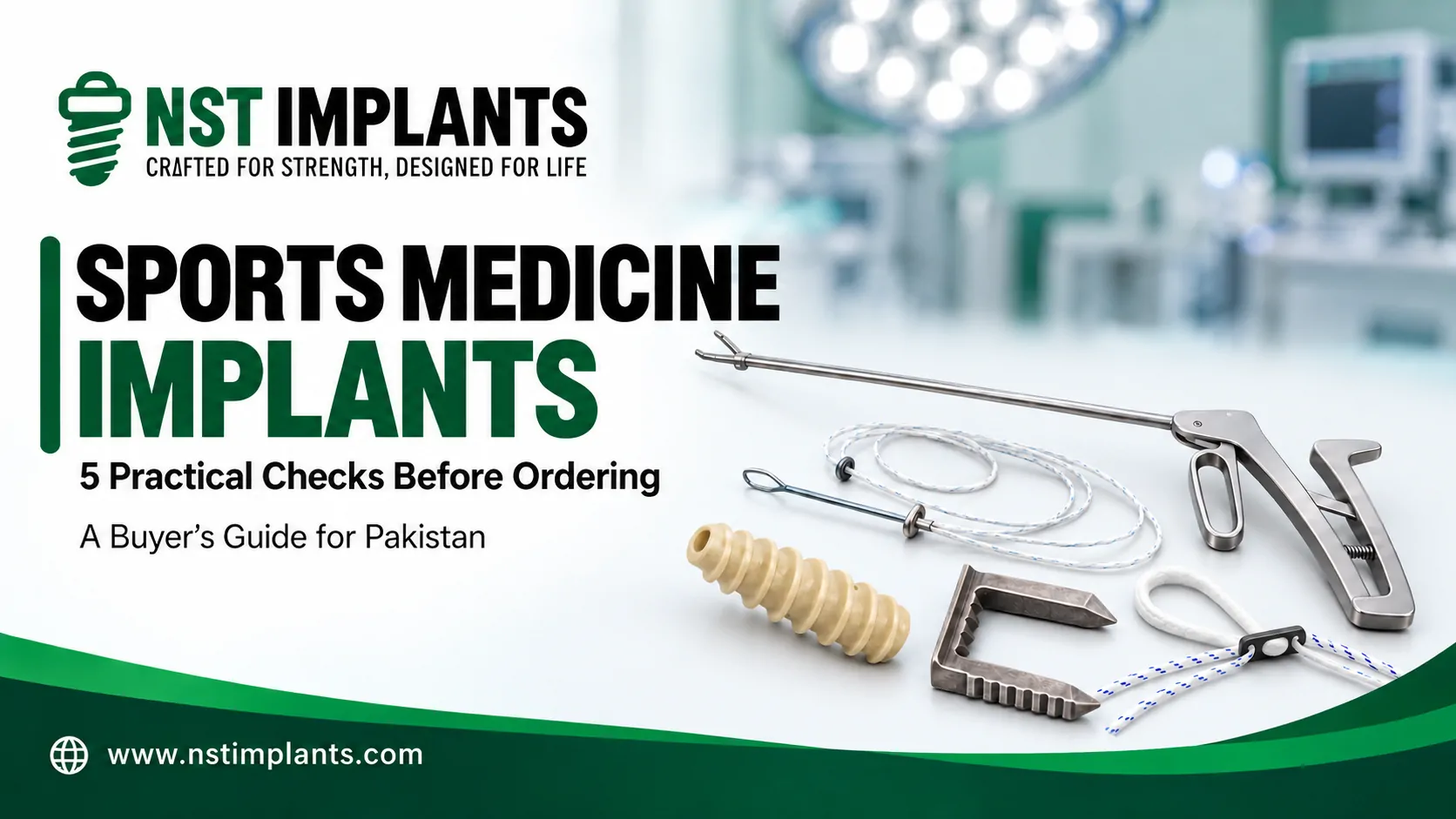
Sports Medicine Implants: 5 Essential Checks Before Ordering
Sports medicine implants are orthopedic fixation devices used in selected ligament reconstruction, tendon repair and soft tissue repair procedures. Common examples include suture anchors, interference screws and cortical button systems. For hospitals, orthopedic distributors and clinicians in Pakistan, selecting a product involves reviewing its intended use, configuration, compatible instruments and supporting documentation.
A clear purchasing specification helps connect the surgeon’s requirements with the procurement process. Product names alone rarely provide enough information to finalize an order.
This guide explains the main implant categories, introduces all-suture anchors and outlines five practical checks before requesting product information from NST Implants.
What Are Sports Medicine Implants?
Sports medicine implants provide fixation as part of selected orthopedic repair or reconstruction procedures. Depending on the device and technique, they may secure soft tissue to bone or support graft fixation.
Shoulder surgery offers one example. The American Academy of Orthopaedic Surgeons explains that selected arthroscopic procedures use devices to anchor sutures into bone. Its guidance on certain labral tears also describes reattachment using suture anchors. These general applications do not establish the indications of every individual product.
The term “sports medicine” does not restrict these devices to professional athletes. Clinical suitability depends on the diagnosed condition, planned procedure and device-specific instructions.
Main Types of Sports Medicine Implants
Different fixation systems serve different purposes. An anchor, screw and button should be evaluated within its intended system.
| Implant category | General fixation role | Purchasing information to confirm |
|---|---|---|
| Suture anchors | Provide a bone attachment point for sutures in selected soft tissue repairs | Dimensions, material, supplied sutures and insertion tools |
| All-suture anchors | Use a soft anchoring component rather than a conventional rigid body | Exact model, deployment requirements and compatible instruments |
| Interference screws | Secure grafts or soft tissue within bone tunnels in selected reconstruction procedures | Diameter, length, material and matching driver |
| Cortical button systems | Provide suspensory fixation in selected reconstruction systems | Button dimensions, loop configuration and instrument requirements |
NST’s sports medicine product range lists anchor, interference screw and button-related options. Confirm each product’s configuration using current technical documentation before ordering.
Understanding All-Suture Anchors
An all-suture anchor uses a suture or textile anchoring component instead of a conventional rigid anchor body. Construction and deployment methods vary between models.
Some designs use relatively small preparation holes. However, the dimensions, handling requirements and mechanical performance must be assessed for the exact device. “All-suture” does not automatically mean stronger fixation or faster recovery.
A primary biomechanical study involving human humeri found that the pullout strength of the tested all-suture anchor was associated with local cortical thickness. This finding concerns a laboratory model and should not be interpreted as an NST-specific performance claim.
“All-suture” and “knotless” also describe different features. The first refers to the anchoring component; the second concerns how the system secures its sutures. Buyers should confirm both characteristics rather than infer them from a product name.
NST Implants’ All-Suture Anchor Listings
NST’s catalogue includes:
- Sensitiva Soft Anchor All Suture: reference 778510020.
- Sensitiva Soft Anchor All Suture Mini: reference 778510010.
These entries appear on the second sports medicine catalogue page. Their listing confirms the displayed names and references, rather than current stock or complete specifications.
Request the technical sheets to compare dimensions, supplied sutures, intended applications and compatible instruments. The word “Mini” alone is insufficient to determine clinical suitability.
5 Essential Checks Before Buying Sports Medicine Implants
1. Confirm the Exact Reference and Configuration
Include the product name, reference, requested configuration and quantity in the inquiry. Use dimensions specified by the clinical team and confirmed in the technical sheet.
For an anchor, clarify the material and suture configuration. For a button system, identify the required loop arrangement. For an interference screw, confirm the diameter, length and driver.
Do not interpret a catalogue reference number as a dimension.
2. Review the Intended Use and Product Documentation
Request the device’s instructions for use, including indications, contraindications, warnings and handling requirements.
The clinician should assess whether the device fits the proposed procedure. Procurement staff should then confirm that the quoted reference matches the reviewed specification.
General website descriptions cannot replace device-specific documentation.
3. Verify Instrument Compatibility
Sports medicine implants may require matching drills, guides, inserters or drivers. Ask what is included and what must be purchased separately.
If the hospital intends to use existing instruments, obtain documented compatibility confirmation. Similar appearance or naming does not establish interchangeability between systems.
Including the required instruments in the quotation helps the purchasing team assess the complete order.
4. Check Packaging, Sterility and Traceability
Confirm the supplied product’s sterility status, storage conditions, packaging requirements and expiry date where applicable.
Request lot or batch identification and documentation relevant to the exact device being supplied in Pakistan. Ensure that documents correspond to the selected product rather than assuming a general certificate covers the entire catalogue.
For reusable instruments, obtain the relevant processing instructions.
5. Confirm Availability and Delivery Terms
Request written confirmation of stock, quantity, delivery city, lead time and quotation validity.
Compare the complete purchasing cost, including any separately required instruments and accessories. A lower implant price may not represent a lower total order cost.
An online listing should not be treated as confirmation that the requested quantity is immediately available.
Comparing Sports Medicine Implants Responsibly
A useful comparison focuses on specific systems and the surgeon’s requirements. Relevant factors include preparation dimensions, deployment method, suture configuration, instrument compatibility and documented intended use.
Laboratory studies describe performance under defined testing conditions. They do not directly establish healing, rehabilitation timelines or return-to-sport outcomes.
A cadaveric study comparing several all-suture designs with a conventional anchor reported differences in mechanical behavior. This supports evaluating individual devices rather than assuming every product in a category performs identically.
For procurement teams, the goal is to gather enough accurate information for clinical review and confirm that the complete system can be supplied.
Frequently Asked Questions
Are sports medicine implants orthopedic implants?
Yes. They form part of the broader orthopedic implant field and include devices used in selected soft tissue repair and reconstruction procedures.
Does NST Implants list all-suture anchors?
Yes. NST lists Sensitiva Soft Anchor All Suture and its Mini variant. Contact the team to confirm current specifications, configurations and availability.
Are all-suture anchors always better than rigid anchors?
No universal advantage can be assumed from the category alone. Comparison requires product-specific evidence, clinical assessment and consideration of the planned repair.
Can existing hospital instruments be used?
Only when compatibility has been confirmed for the exact system. Request the required instrument list and supporting compatibility information before ordering.
What details should a quotation request include?
Provide the product reference, configuration, quantity, delivery city and required timing. Request technical documentation, packaging information and details of any additional instruments.
Request Sports Medicine Implant Details from NST Implants
A complete inquiry starts with the clinical specification and includes the instruments, documentation and delivery information needed for purchasing.
Explore NST’s sports medicine implants catalogue or contact NST Implants to request technical information, current availability and a quotation.
Email: info@nstimplants.com
Phone: +92 300 970 9100
Website: nstimplants.com